
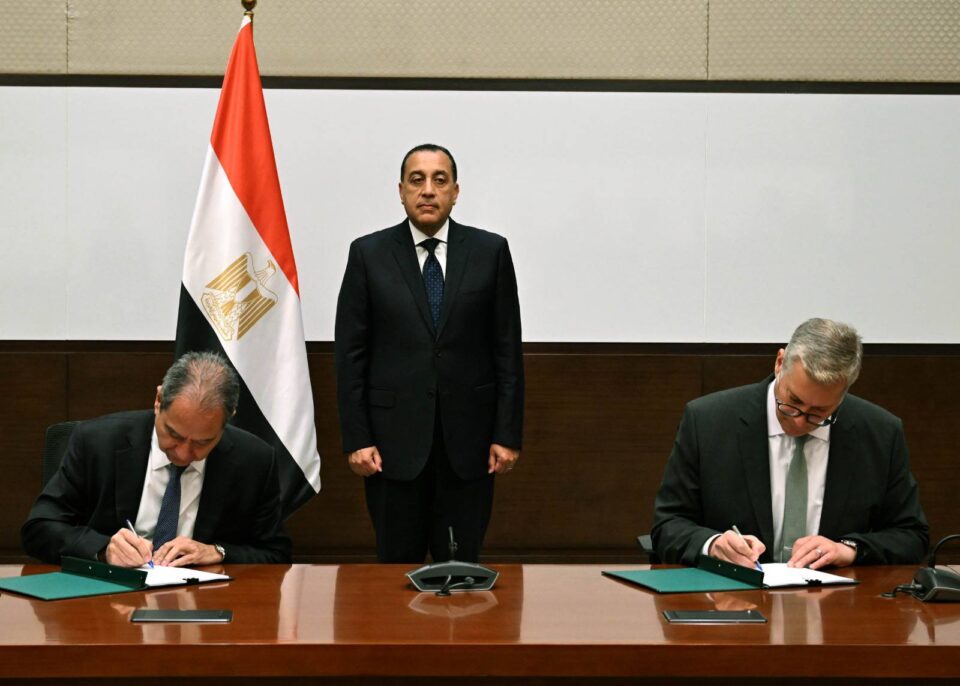
Egypt-Lebanon Gas Network Rehabilitation Agreement: Strategic Cooperation Powered by Egyptian Petroleum Expertise
New Administrative Capital – Government Press Office |
Dr. Mustafa Madbouly, Prime Minister of Egypt, witnessed the signing ceremony of a new agreement this morning. The event took place at the government headquarters in the New Administrative Capital. The agreement aims to execute repair and rehabilitation works for gas pipelines in the Lebanese Republic. Furthermore, implementation will be carried out by Egypt’s petroleum sector, represented by the Technical Company for Gas Pipeline Operations Services (TGS).
Signing Details and Participating Parties
In this context, the agreement was signed by Eng. Karim Badawi, Minister of Petroleum and Mineral Resources, representing the Egyptian side. Additionally, Dr. Joseph Al-Sadi, Minister of Energy and Water, signed on behalf of the Lebanese side. Moreover, the ceremony was attended by senior leaders from Egypt’s petroleum sector. Likewise, a delegation of Lebanese energy and petroleum officials was present. Notably, Dr. Ali El-Halabi, Lebanon’s Ambassador to Egypt, also attended the signing.
Prime Minister’s Statements: Strategic Support for Regional Cooperation
Following the signing, Dr. Mustafa Madbouly highlighted the significance of this agreement. He stated that the pact falls within the framework of supporting and enhancing cooperation with the Lebanese government. This cooperation spans various fields and sectors, particularly the vital energy sector. Furthermore, the Prime Minister confirmed that this agreement represents a tangible translation of the outcomes from his visit to Beirut last December.
From another perspective, Madbouly emphasized that the visit prioritizes cooperation in the energy field. Consequently, necessary support is being provided in this vital sector to serve the brotherly Lebanese people. Additionally, the Prime Minister added that Egypt’s petroleum sector is placing its specialized technical expertise in natural gas networks at the service of our brethren in Lebanon. As a result, this cooperation reflects the depth of relations between the two countries. Moreover, it underscores Egypt’s commitment to supporting Lebanon’s capacities. Thus, the efficiency and rehabilitation of Lebanon’s gas infrastructure will be enhanced. Subsequently, this ensures the sustainability of energy supplies.
Petroleum Minister: Egyptian Expertise Ready for Regional Projects
Meanwhile, Eng. Karim Badawi, Minister of Petroleum and Mineral Resources, highlighted the agreement’s importance. He stated that the pact confirms the readiness of Egyptian petroleum companies. Furthermore, it demonstrates their capacity to execute specialized projects outside Egypt. This capability relies on their extensive and accumulated expertise. Additionally, operations for operating and maintaining natural gas pipelines and networks adhere to international standards. As a result, this enhances the Egyptian petroleum sector’s regional participation in gas infrastructure projects.
Technical Specifications: 30 km of Advanced Gas Pipelines
In this framework, the Petroleum Minister clarified the technical details of the agreement. He stated that, under the agreement, the Technical Company for Gas Pipeline Operations Services (TGS) will execute the required works. These works include repairing and rehabilitating gas pipelines with a 24-inch diameter. Moreover, the pipelines extend approximately 30 kilometers in length. Additionally, the project encompasses upgrading pressure reduction and metering stations. Furthermore, associated electrical stations will also be enhanced.
Technical Upgrades: Automated Control Systems and Advanced Protection
The Minister added further details regarding the required technical works. He stated that the scope includes executing specialized mechanical installations. Moreover, the project involves updating Programmable Logic Controller (PLC) automated control systems. Additionally, Supervisory Control and Data Acquisition (SCADA) systems will be modernized. Furthermore, the works include implementing cathodic protection systems for the pipelines. Notably, necessary technical and operational tests will be conducted. As a result, this prepares for the re-commissioning of pipelines and stations with high efficiency. Likewise, it ensures high reliability in network performance post-rehabilitation.